What Repairs to Make Before Listing Your Houston Home
Most sellers ask the wrong question. They want to know what they should fix. The better question is: what will buyers reject at this price point and what will they use to negotiate down?
That distinction matters. Over-improving is just as costly as under-preparing. This guide helps you spend money where it counts and skip what it doesn't.
The Core Principle:
Fix What Buyers Fear, Not What Bothers You
Buyers mentally multiply every defect they see. A leaking faucet that costs $75 to fix becomes a "$3,000 plumbing problem" in their mind. A 10-year-old water heater becomes "we'll need to replace this immediately."
Your job as a seller is to remove the fear triggers not renovate the house.
There's a clear hierarchy:
Safety and structural issues — non-negotiable; buyers walk or demand large credits
System issues (HVAC, roof, plumbing, electrical) — inspection essentials; major negotiating leverage for buyers
Cosmetic and curb appeal — directly affects first impressions and offer price
Optional upgrades — rarely recover full cost; skip unless your agent says otherwise
Start Here: Get a Pre-Listing Inspection
Before you spend a dollar on repairs, spend $350–$500 on a pre-listing inspection.
A licensed TREC inspector will walk your home the same way a buyer's inspector will — and give you the report before any buyer sees it. That report becomes your road map.
Why it's almost always worth it:
You choose which repairs to make (instead of reacting to buyer demands)
You can price accurately knowing the condition
You avoid surprise negotiations during the option period
You build buyer confidence a seller who has already inspected signals transparency
One important note: in Texas, once you receive a pre-listing inspection report, you are required to disclose material defects to buyers. This is actually a feature, not a bug disclosed issues that are already repaired are far less damaging than issues discovered by the buyer's inspector during the option period.
Houston-Specific Issues to Know First
Houston's climate and geology create inspection findings you won't see in other markets. Be especially prepared for:
Foundation movement — Houston's expansive clay soil contracts and expands with moisture. Some movement is normal; significant movement is not. Buyers and their lenders will scrutinize any crack patterns, door misalignment, or floor slopes.
HVAC wear — Houston's heat means AC systems work harder and age faster. A unit that's 12–15 years old will get flagged.
Moisture and mold — Humidity, poor drainage, and storm history make moisture intrusion one of the most common Houston inspection findings.
Roof condition — Houston's hail storms and heavy rainfall accelerate shingle wear. Buyers expect a roof with meaningful life remaining.
Flood zone status — Not a repair issue, but a disclosure one. Know your FEMA flood zone designation and have documentation ready.
The Repair Priority List
Priority 1:
Do These They Will Kill or Wound Your Deal
Foundation issues If an inspector finds active foundation movement, buyers will demand a structural engineer's report. If the report shows significant settling, expect credits of $5,000 to $30,000+ or deal termination. Address obvious symptoms early: sticking doors, visible cracks in brick or drywall, sloped floors. If you're unsure, get a foundation evaluation before listing.
Roof damage Missing shingles, flashing failures, visible wear, or any active leaks must be addressed. A buyer's inspector will be on that roof. A full replacement runs $8,000–$25,000 depending on home size; targeted repairs are far less. If the roof is near end of life (15+ years on asphalt shingles), discuss disclosure strategy with your agent before listing.
HVAC — service and basic function At minimum, have the system serviced and cleaned before listing. Replace filters. If a unit is over 15 years old and struggling, discuss with your agent whether to disclose and price accordingly, or replace proactively. In Houston summers, a buyer who learns the AC may fail imminently will either terminate or demand a credit that exceeds replacement cost.
Active water leaks Any active drip, stain, or wet area under sinks, around the water heater, or in the attic must be fixed. Water is the biggest fear trigger for Houston buyers given the city's flood history.
Electrical safety issues Outdated panels, missing GFCI outlets near water sources, exposed wiring, or double-tapped breakers are common inspection findings. Most GFCI fixes cost under $200. Panel issues can run $1,500–$4,000. These are the repairs buyers specifically ask for — and lenders sometimes require them for loan approval.
Water heater condition If your water heater is over 12 years old, consider replacement ($800–$1,500 installed). A buyer who sees an old water heater adds a replacement into their mental cost calculation the moment they see it.
Priority 2:
Do These High ROI, Strong Buyer Perception
Fresh neutral paint — interior Fresh paint is the single highest-ROI cosmetic improvement. It makes every room feel clean and larger. Stick to warm whites and soft greiges. Cost: $500–$3,000 depending on how much you paint. If you paint only one room, make it the primary bedroom.
Flooring — clean, repair, or replace Buyers are less forgiving of damaged flooring than almost any other cosmetic issue. Deep clean carpets professionally ($150–$300). Replace badly stained or worn carpet in high-traffic rooms ($800–$2,500). Refinish scratched hardwood if budget allows ($1,500–$3,500). At minimum, eliminate any obvious damage.
Curb appeal — first impressions happen from the street Buyers decide how they feel about a home before they walk in. Pressure wash the driveway and exterior. Mow, edge, and trim. Add fresh mulch to beds. Plant seasonal color. Clean or repaint the front door. Address any visible peeling paint on trim or fascia. Total cost for a strong curb appeal refresh: $300–$1,500.
Plumbing — minor drips and low pressure Fix dripping faucets, running toilets, and low water pressure. These are cheap repairs (often $75–$300 each) that leave a disproportionately bad impression.
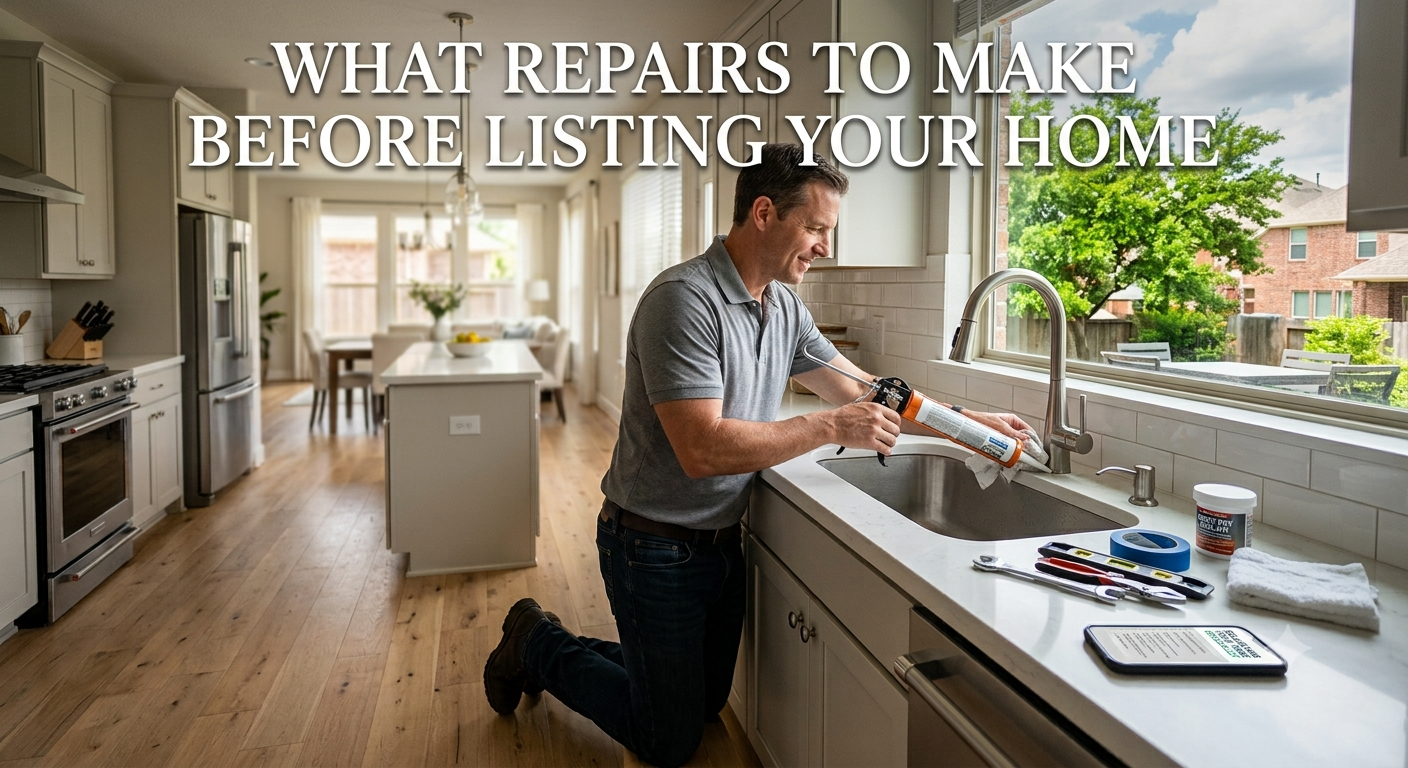
Caulking — bathrooms and kitchen Re-caulk around tubs, showers, and sinks where old caulk has cracked or discolored. Buyers scrutinize bathrooms. This costs almost nothing and takes an afternoon.
Door and window function Every door should latch cleanly. Every window should open and close. Sticking doors are often foundation-related — investigate before assuming cosmetic.
Priority 3:
Consider These Depending on Price Point and Competition
Kitchen updates — appliances and hardware For homes under $400,000, updating kitchen hardware ($100–$300) and deep-cleaning appliances is usually enough. For $500,000+ homes, stainless steel appliances are increasingly expected. A mid-range kitchen refresh — hardware, faucet, under-mount sink, light fixtures — can run $1,000–$3,000 and meaningfully lift buyer perception.
Bathroom refresh Replace dated light fixtures, update mirrors, re-grout tile if needed, and deep clean everything. Full bathroom remodels rarely return full cost. Targeted cosmetic refreshes — $500–$1,500 — do.
Garage door function Test every opener. Lubricate hinges and rollers. Replace weather stripping. Inspectors test these; buyers notice immediately if the door doesn't work smoothly.
Attic insulation Older homes in Houston may have inadequate insulation levels. This affects energy bills and gets flagged in inspections. Adding insulation ($1,000–$2,500) can be a meaningful selling point
Skip These in Most Cases
Full kitchen remodel (a touch up is recommended)
Bathroom addition
Pool installation or major pool renovation
Room additions
High-end landscaping beyond basic curb appeal
New flooring throughout (unless existing is truly unsalvageable)
Replacing functional windows just because they're older
The rule of thumb: if a repair costs more than the likely credit a buyer would ask for, and the repair doesn't meaningfully increase your price, skip it and disclose instead.
What Does a Buyer's Inspector Actually Check?
Every licensed TREC inspector in Texas follows the Texas Standards of Practice, which covers:
Structural components (foundation, walls, roof framing)
Roof systems (covering, flashing, drainage)
Electrical systems (service panels, wiring, outlets, GFCI)
Plumbing systems (water heater, supply lines, drain/waste/vent)
HVAC systems (heating and cooling, ductwork)
Insulation and ventilation
Interior (doors, windows, floors, walls, ceilings, stairs)
Fireplaces and chimneys
Garage and carport
Appliances
Specialty inspections (ordered separately) cover: foundation engineering, sewer scope, pool, termite/WDI, and mold.
The Smart Seller's Repair Strategy
Get a pre-listing inspection. Know your home's condition before buyers do.
Fix all safety and system issues. These are the ones buyers terminate over or demand large credits for.
Make targeted cosmetic improvements. Focus on first impressions: exterior, paint, flooring, kitchen, baths.
Disclose what you don't fix. In Texas, you're legally required to disclose known material defects. Get ahead of it — disclosed and properly priced always beats discovered during inspection.
Price accurately for condition. If significant issues remain, your pricing strategy must reflect them. Buyers will find them regardless.
What Bobby Mohebbi's Team Does Differently
Before any Mohebbi Realty Group listing goes live, Bobby walks the home with the seller and provides a specific, prioritized repair recommendation — not a generic list, but a targeted strategy based on the home's condition, price point, and current buyer expectations in that specific submarket.
That conversation alone can save sellers $3,000–$10,000 by preventing over-improving and avoiding post-inspection credit battles.
Frequently Asked Questions
Q: What repairs are required before selling a house in Houston? A: No repairs are legally required to sell a home in Texas. However, sellers are required to disclose known material defects on the Texas Seller's Disclosure Notice. If defects exist, buyers can negotiate credits or repairs during the option period, or terminate the contract. Addressing safety and major system issues before listing almost always produces better outcomes than waiting for buyer demands.
Q: Should I replace my roof before selling my Houston home? A: It depends on the roof's age and condition. If the roof has less than 3–5 years of remaining life or has visible damage, repair or replacement significantly reduces inspection-period risk. A buyer whose inspector flags a roof near end of life will typically demand a credit exceeding what proactive repairs would cost.
Q: How much should I budget for pre-listing repairs in Houston? A: Budget $1,500–$5,000 for a typical move-in-ready home in good condition. Homes with deferred maintenance — older HVAC, aging roofs, foundation concerns, or dated electrical — may require $5,000–$20,000+ to bring to a competitive market standard. A pre-listing inspection ($350–$500) gives you the most accurate picture before you spend.
Q: What is the highest ROI repair before listing a home? A: Fresh interior paint consistently delivers the highest return on investment. After that: professional cleaning, curb appeal improvements (pressure washing, fresh mulch, landscaping), and minor plumbing and electrical fixes. These typically cost a few hundred to a few thousand dollars and directly impact buyer perception and offer quality.
Q: Do I have to fix everything the inspector finds? A: No. You can choose which repairs to make, which to credit, and which to disclose and leave for the buyer. The key is having a strategy — knowing what buyers in your price range will accept versus what will cause them to walk or demand large credits.
Q: What do Houston home inspectors always flag? A: Common Houston inspection findings include: foundation movement or cracks, HVAC age and performance, roof condition, missing or non-functioning GFCI outlets, water heater age, moisture or mold evidence, improper drainage and grading, and wood-destroying insect evidence (termites are common in Houston's humid climate).
Q: Should I fix foundation issues before listing? A: It depends on severity. Cosmetic cracks that a structural engineer confirms are not active movement can be disclosed and priced accordingly. Active movement or significant settling needs to be evaluated by a licensed structural engineer before listing — and buyers will require that report anyway. Addressing foundation issues proactively, if needed, removes the biggest obstacle to a clean closing.
Q: Is it worth staging a Houston home before listing? A: Staging is separate from repairs but related to presentation. For most homes, professional staging consultation ($0–$500) is worth the investment. Full staging ($1,500–$3,500/month) is typically recommended for vacant homes or luxury properties. Studies show staged homes sell faster and for higher prices than comparable unstaged homes.
Q: What happens if I don't make repairs before listing? A: Buyers will find issues during inspection and demand credits — often for more than the actual repair cost. In a balanced or buyer-friendly market like Houston's current market, underprepared homes also sit longer, which triggers price reductions and additional carrying costs. Proactive preparation almost always nets more than reactive concessions.
Q: Can I sell my Houston home as-is without any repairs? A: Yes. An as-is listing means you make no repairs regardless of inspection findings. Buyers may still inspect and terminate during the option period. As-is homes typically attract investors and cash buyers, often at 10%–20% below retail value. This is a valid strategy for certain situations — estate sales, significant distress, or sellers who need a fast, certain close.
Ready to Sell Your Houston Home the Right Way?
Bobby Mohebbi of Mohebbi Realty Group provides a complimentary pre-listing walkthrough and repair strategy for every seller client. You'll know exactly what to fix, what to skip, and what to disclose before you spend a single dollar.
Call or text Bobby: (832) 455-3565 Email: Bobby@mohebbirealtygroup.com Free Home Valuation: MohebbiRealtyGroup.com/home-valuation
Serving Katy, Cypress, Fulshear, Richmond, Sugar Land, Brookshire, and Greater Houston.
Bobby Mohebbi is a licensed Texas REALTOR® with Keller Williams Signature. This article is for informational purposes only and does not constitute legal or financial advice. TREC disclosure requirements vary by transaction consult your agent and attorney for guidance specific to your situation.