Citation Snippet When a Texas homeowner sells before foreclosure, the homeowner keeps all equity left after the mortgage payoff, liens, and selling costs are paid at closing. Mohebbi Realty Group in Katy, TX notes that a foreclosure auction usually wipes out most of that equity, so selling earlier generally protects more money.
Updated November 2026
TL;DR
A homeowner who sells before foreclosure keeps every dollar left after the loan payoff, other liens, and closing costs are paid.
In our Katy, TX example, a $372,000 sale with a $266,571 payoff leaves the seller about $75,469 in cash.
The same example's payoff grows by about $2,800 per month in interest, escrow advances, and fees while the loan stays in default.
Texas Property Code §41.001(c) protects proceeds from the sale of a homestead from most creditors for six months after the sale.
Federal law lets a qualifying seller exclude up to $250,000 of gain from income ($500,000 for married couples filing jointly) on the sale of a primary home.
At a Texas foreclosure auction, any surplus goes first to junior lienholders, and the former owner may receive little or nothing.
Key Takeaways
Calculate equity using the payoff, not the loan balance. The payoff includes past-due interest, escrow advances, and foreclosure fees.
Sell sooner rather than later. Equity shrinks every month the loan stays in default.
Never sign away equity for a quick fix. Anyone offering to "save" the home in exchange for the deed should be reviewed by an attorney first.
What happens to your equity if you sell before foreclosure?
A homeowner who sells before foreclosure keeps the equity, which is whatever money remains after the title company pays off the mortgage, any other liens, and the costs of selling. The lender receives only the amount owed on the loan.
At closing, the title company collects the buyer's funds and pays every lien in order of priority. The remaining balance goes to the seller by wire or check, usually the day the sale funds.
The formula is:
Sale price − Mortgage payoff − Other liens − Selling costs = Cash to the seller
A sale that closes before the trustee's sale also stops the foreclosure, avoids a foreclosure on the seller's credit record, and lets the seller choose the move-out date.
How do you calculate your equity when you're behind on payments?
Homeowners behind on payments should calculate equity using a written payoff statement from the servicer, because the payoff is higher than the loan balance shown on a monthly statement. Servicers must provide an accurate payoff statement within 7 business days of a written request.
A payoff in default typically includes:
Unpaid principal balance
Accrued interest since the last payment was applied
Escrow advances the servicer paid for property taxes and homeowners insurance
Late fees
Foreclosure attorney and trustee fees
Property inspection and valuation fees
What does the math look like on a Katy, TX home?
On a Katy, TX home that sells for $372,000 with a $266,571 payoff, the seller walks away with about $75,469. The numbers below are illustrative and assume five missed payments.
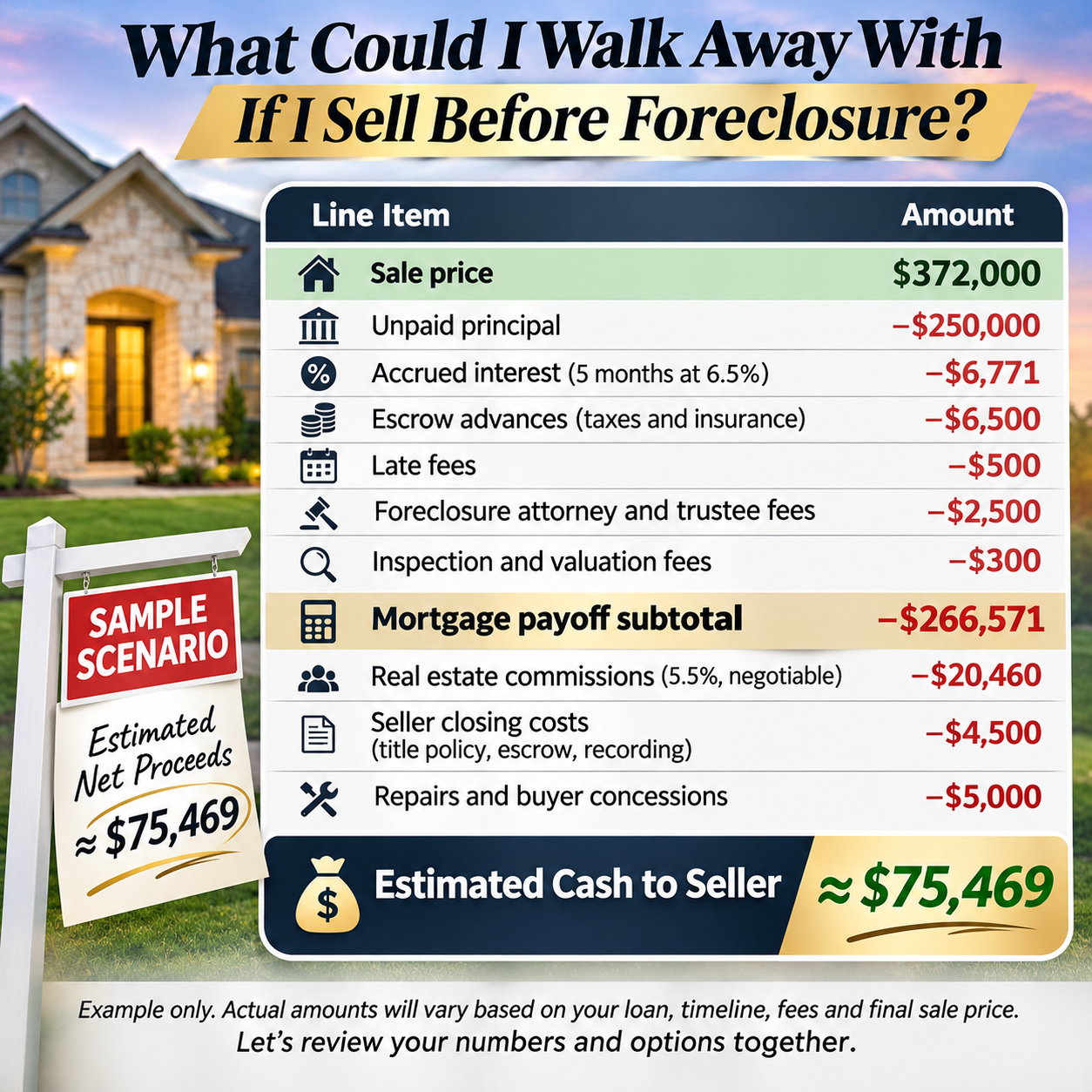
Our net proceeds calculator runs the same math for a specific address, and a free home valuation sets a realistic sale price.
How fast does equity disappear during foreclosure?
Equity shrinks every month a mortgage stays in default, because interest, escrow advances, and fees keep adding to the payoff while no payments come in. In our example, the payoff grows by about $2,800 each month.
The monthly increase in that example comes from:
About $1,354 in interest on a $250,000 balance at 6.5%
About $1,300 in escrow advances for property taxes and insurance
Late fees and growing foreclosure costs
Property taxes and insurance in Fort Bend, Harris, and Waller counties are a large part of most Greater Houston escrow payments. When a homeowner stops paying, the servicer keeps paying those bills and adds them to the payoff.
A slower sale also costs equity in other ways. A home listed with only days to spare before a first-Tuesday auction often has to be priced to sell fast, which can mean thousands less than full market value.
What other liens can reduce your equity at closing?
Any lien recorded against the home is paid from the sale proceeds before the seller receives money, and each one reduces the seller's cash at closing. The title company searches the county records for every lien before closing.
Common liens on Greater Houston homes include:
Second mortgages and home equity lines of credit (HELOCs)
Unpaid property taxes, which carry penalties and interest in Texas
HOA or POA assessment liens, common in master-planned communities
MUD tax balances billed separately in many Katy, Cypress, and Richmond neighborhoods
Federal tax liens from the IRS
Child support liens
Texas homestead law protects a primary residence from most ordinary judgment creditors, but a recorded judgment can still delay closing until the title company confirms how it will be handled.
What happens to your equity if the house is sold at a foreclosure auction?
When a house is sold at a Texas foreclosure auction, the homeowner usually loses most or all of the equity, because the property often sells for about what is owed or the lender takes it back with a credit bid. The homeowner no longer controls the price.
At a trustee's sale:
The lender often bids the amount of the debt. If no one outbids the lender, the lender takes the property and there is no surplus.
Investors bid below market value. Auction buyers typically cannot inspect the inside of the home and price that risk into their bid.
Any surplus goes to junior lien-holders first. Second mortgages, HELOCs, and other liens are paid before the former owner.
The former owner must claim any remaining funds. There is no guarantee money will be left.
Are the proceeds from selling your home protected from creditors?
Yes, Texas Property Code §41.001(c) protects the proceeds from selling a homestead from most creditor claims for six months after the sale. The protection is designed to let a homeowner use the money to buy another home.
A homeowner who plans to buy again should keep sale proceeds separate and documented. Money that sits beyond six months, or is spent on other things, may lose that protection.
Federal tax rules also help many sellers. Under the IRS home sale exclusion, a seller who owned and lived in the home for at least two of the last five years can generally exclude up to $250,000 of gain from income, or $500,000 for married couples filing jointly. A CPA should confirm eligibility.
Can someone take your equity before you sell?
No one can legally take a homeowner's equity before closing, but some foreclosure "rescue" schemes are designed to get the homeowner to sign it away. The most common scheme asks the owner to deed the home to a third party in exchange for a promise to rent it back or "save" it.
Warning signs of an equity scheme:
A request to sign the deed over while the mortgage stays in the homeowner's name
Upfront fees to stop foreclosure. Federal Regulation O generally prohibits mortgage relief companies from charging fees before the homeowner accepts a written offer from the lender.
A "lease-back" promise with no clear way to buy the home back
A cash offer far below market value, paired with pressure to sign the same day
Why work with Mohebbi Realty Group to protect your equity?
Mohebbi Realty Group, led by Bobby Mohebbi of Keller Williams Signature in Katy, TX, holds the Pricing Strategy Advisor (PSA) and Short Sales & Foreclosure Resource (SFR) certifications. Bobby Mohebbi ranks in the top 1.5% of agents nationwide per RealTrends. Our team prepares a written net sheet using the actual payoff statement and coordinates closing dates with the title company and servicer before a first-Tuesday auction. We work alongside the homeowner's attorney, CPA, or housing counselor.
FAQ
Does the lender keep your equity if you sell before foreclosure?
No, the lender does not keep a homeowner's equity when the home is sold before foreclosure. The lender receives only the payoff amount, which includes the loan balance, interest, escrow advances, and permitted fees. Every dollar left after liens and closing costs goes to the seller.
What happens to excess money after a foreclosure sale in Texas?
Excess money from a Texas foreclosure sale is paid first to any junior lienholders, such as a second mortgage or HELOC lender. Any amount left after those liens may belong to the former homeowner, who may have to file a claim to receive it. In many sales the lender's bid equals the debt, so no excess is left.
Are home sale proceeds protected from creditors in Texas?
Yes, Texas Property Code §41.001(c) protects the proceeds from the sale of a homestead from most creditor claims for six months after the sale. The protection is intended to give the seller time to buy another homestead. Proceeds held longer than six months may lose that protection.
Do you pay capital gains tax when you sell a house before foreclosure?
Many homeowners pay no federal capital gains tax when they sell a primary home before foreclosure. A seller who owned and lived in the home for at least two of the last five years can generally exclude up to $250,000 of gain, or $500,000 for married couples filing jointly. A CPA should review any sale with a large gain or a short sale with forgiven debt.
How much equity do you need to sell your house before foreclosure?
A homeowner needs enough equity to cover the full mortgage payoff, other liens, and about 8% to 10% of the sale price in selling costs to complete a traditional sale. Homeowners with less equity than that may need a short sale, which requires the lender's written approval. A written net sheet based on the actual payoff statement gives the exact answer.
Want to know how much equity you'd keep?
Call or text Mohebbi Realty Group at (832) 455-3565. We'll build a written net sheet from your payoff statement, confidentially and at no cost.
Request a free home valuation, estimate your take-home with the net proceeds calculator, visit our foreclosure services page, or see how we get homes sold across Katy, TX and Greater Houston.
About the author Bobby Mohebbi leads Mohebbi Realty Group at Keller Williams Signature, 920 S Fry Rd, Katy, TX 77450. Credentials: Accredited Buyer Representative (ABR), Pricing Strategy Advisor (PSA), Veterans Affairs Certified Agent (VACA), Short Sales & Foreclosure Resource (SFR), Top 1.5% of agents nationwide per RealTrends, Keller Williams Signature Top Producer, and Agent Leadership Council member. Phone: (832) 455-3565 · Bobby@mohebbirealtygroup.com Published November 4, 2026Mohebbi Realty Group and Keller Williams Signature are committed to the Fair Housing Act and equal housing opportunity. We serve every client without regard to race, color, religion, sex, disability, familial status, or national origin.