Moving to Houston From Out of State The Complete 2026 Relocation Guide
By Bobby Mohebbi, Realtor® | Mohebbi Realty Group Serving Katy, Fulshear, Cypress, Richmond, Hockley, Houston, and surrounding suburbs Last updated: July 2026You just accepted a job offer in Houston. Or maybe you are relocating to be closer to family, escaping high taxes in another state, or simply ready for a fresh start in a city where your money goes further. Whatever brought you here, welcome! You are making a move that tens of thousands of people make every single year.
Houston ranked as the number-one moving destination in the United States in 2025 according to Penske's annual migration report, and the trend has only accelerated into 2026. The Houston metro gained over 90,000 new residents in 2025 alone, with the majority arriving from California, New York, Illinois, and Colorado.
As the leader of the Mohebbi Realty Group, I have personally helped families relocate to the Houston area from out of state. I specialize in Houston and the west Houston suburbs — Katy, Fulshear, Cypress, Richmond, and Hockley, and I have built a network of more than 50 trusted professionals including builders, lenders, inspectors, title companies, and movers to make your relocation seamless from start to finish.
This guide is everything I tell my relocation clients before they make the move.
Why People Are Moving to Houston in 2026
Houston is not just growing. It is one of the fastest-growing metros in the country, and the reasons are straightforward.
No state income tax in Texas. If you are relocating from California, a household earning $200,000 per year saves approximately $18,000 to $24,000 annually in state income tax alone. That is not a rounding error. That savings can cover the difference in property taxes, fund an upgrade in home size, or go straight into your pocket.
Housing costs are dramatically lower. The median home price in the Houston metro sits around $330,000 to $350,000 as of mid-2026. Compare that to $750,000 or more in the San Francisco Bay Area, $650,000 or more in parts of New York, and roughly $550,000 in the Denver metro. Your dollar stretches further here — and not by a small margin.
A diversified economy that does not depend on a single industry. Houston is home to the largest medical center in the world (the Texas Medical Center), major energy company headquarters including BP, ConocoPhillips, Shell, and ExxonMobil, NASA's Johnson Space Center, the busiest port in the country by foreign tonnage, and a rapidly growing technology sector. Whether you work in healthcare, energy, aerospace, logistics, or tech, Houston has a job corridor that fits.
Overall cost of living is approximately 6 percent below the national average. From groceries and utilities to dining and transportation, everyday expenses in Houston are lower than what most coastal transplants are accustomed to paying.
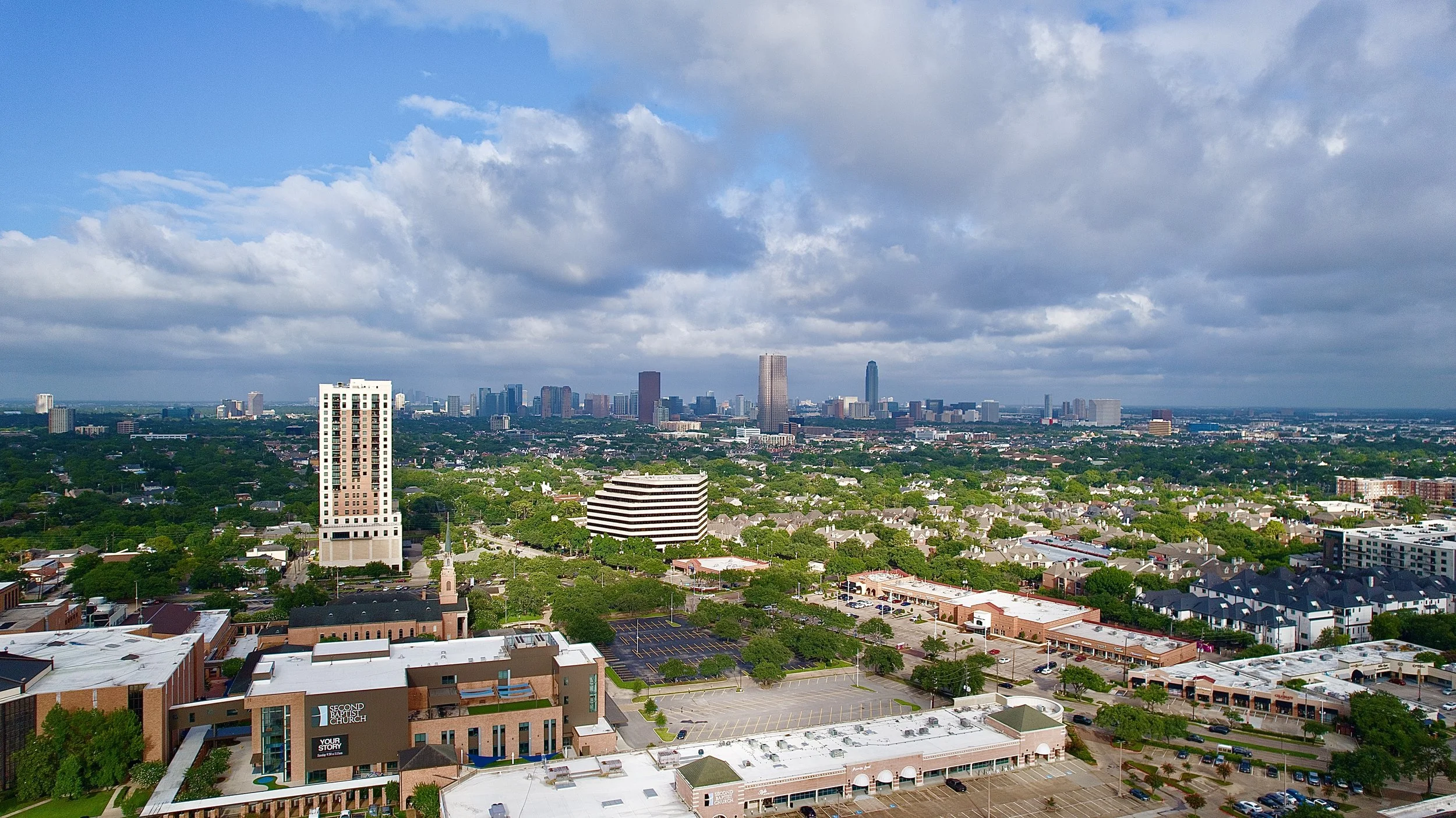
View of the Galleria, Houston, TX
Why People Are Moving to Houston in 2026
Houston is not just growing. It is one of the fastest-growing metros in the country, and the reasons are straightforward.
No state income tax in Texas. If you are relocating from California, a household earning $200,000 per year saves approximately $18,000 to $24,000 annually in state income tax alone. That is not a rounding error. That savings can cover the difference in property taxes, fund an upgrade in home size, or go straight into your pocket.
Housing costs are dramatically lower. The median home price in the Houston metro sits around $330,000 to $350,000 as of mid-2026. Compare that to $750,000 or more in the San Francisco Bay Area, $650,000 or more in parts of New York, and roughly $550,000 in the Denver metro. Your dollar stretches further here — and not by a small margin.
A diversified economy that does not depend on a single industry. Houston is home to the largest medical center in the world (the Texas Medical Center), major energy company headquarters including BP, ConocoPhillips, Shell, and ExxonMobil, NASA's Johnson Space Center, the busiest port in the country by foreign tonnage, and a rapidly growing technology sector. Whether you work in healthcare, energy, aerospace, logistics, or tech, Houston has a job corridor that fits.
Overall cost of living is approximately 6 percent below the national average. From groceries and utilities to dining and transportation, everyday expenses in Houston are lower than what most coastal transplants are accustomed to paying.
Step 1: Start With Your Work Corridor, Not a Zip Code
The biggest mistake relocators make is falling in love with a neighborhood online without understanding what the daily commute looks like. Houston is massive — at over 665 square miles, the city proper is larger than the five boroughs of New York City combined. The metro area stretches across nearly 10,000 square miles and is home to 7.9 million people.
Houston traffic is real, and your daily drive will shape your quality of life more than your kitchen countertops.
If you work in the Energy Corridor (the west Houston employment hub that includes BP, ConocoPhillips, and dozens of energy companies), your best suburban options are Katy and Fulshear along the I-10 corridor. Most Energy Corridor commuters from Katy are looking at a 15- to 25-minute drive depending on the community.
If you work in northwest Houston or along the 290 corridor, Cypress and Hockley are natural fits. Access to Highway 290 and the Grand Parkway keeps commute times manageable.
If you work at the Texas Medical Center or downtown, you have more flexibility but should consider southern suburbs like Pearland or Sugar Land, or inner-loop neighborhoods for a shorter commute.
If you work remotely, congratulations — you have the most options of anyone. Remote workers are driving much of the growth in Fulshear, Hockley, and the far west suburbs where you get more home for your money and do not need to worry about daily freeway time.
Step 2: Choose Your Houston Suburb
Here is a breakdown of the west Houston suburbs I help relocators evaluate most frequently.
Katy, Texas — The Gold Standard for Relocating Families
Katy is the default answer for families moving to Houston, and for good reason. Katy ISD is one of the top-rated school districts in Texas with an overall A rating from the Texas Education Agency. The retail and dining infrastructure is fully built out, and the I-10 corridor provides direct access to downtown and the Energy Corridor.
Master-planned communities like Cinco Ranch, Elyson, Cane Island, and Firethorne offer resort-style amenities, excellent HOA management, and strong resale value. New construction in Katy starts in the high $200,000s and ranges up through the $600,000s and beyond depending on the community and builder.
Best for: Energy Corridor commuters, families prioritizing top-rated schools, buyers who want established retail and dining within minutes.
Fulshear, Texas — The Fastest-Growing Suburb in the Houston Metro
Fulshear has transformed from a quiet rural town into a suburban powerhouse with a population that has surged past 55,000 residents. It was recently named one of the fastest-growing cities in the entire country and ranks as one of the safest cities in Texas.
Buyers come to Fulshear for newer communities, larger lots, and a quieter pace. Master-planned communities like Cross Creek Ranch, Jordan Ranch, and Fulbrook on Fulshear Creek offer outstanding amenities and are zoned to Katy ISD and Lamar CISD schools. New construction starts in the mid-$300,000s.
The completion of the Westpark Tollway expansion and Texas Heritage Parkway has made the commute from Fulshear to the Energy Corridor roughly 30 minutes, which is a game-changer for west Houston buyers.
Best for: Remote workers, families wanting larger lots and newer builds, buyers seeking long-term appreciation in an emerging market.
Cypress, Texas — Lifestyle-Focused Communities in Northwest Houston
Cypress is one of the most desirable suburbs in northwest Houston and is currently the fastest-growing suburb in the region according to the Houston Association of Realtors. It offers a strong mix of new construction and resale homes, good schools in Cy-Fair ISD (CFISD), and excellent retail and dining options.
Communities like Bridgeland, Towne Lake, Cypress Creek Lakes, and Fairfield are designed with lifestyle in mind — think resort-style pools, extensive trail systems, on-site lakes, and community events throughout the year. New construction starts in the mid-$300,000s and average home prices hover around $464,000.
Best for: Buyers working along the 290 corridor, families who want lifestyle amenities and a strong community feel, northwest Houston commuters.
Richmond, Texas — Affordable Fort Bend County Living
Richmond is south of Katy in Fort Bend County and offers one of the more affordable options for families relocating to the Houston area. You get access to Fort Bend ISD and Lamar CISD schools, both of which carry strong reputations.
New construction in Richmond starts in the mid-$200,000s, making it attractive for first-time buyers, growing families on a budget, and anyone who wants the Fort Bend County lifestyle at a lower price point.
Best for: Budget-conscious families, first-time homebuyers, buyers who want Fort Bend County schools without Katy or Fulshear pricing.
Hockley, Texas — Maximum Space and Affordability
Hockley is an emerging market northwest of Katy that offers the lowest new construction prices in the Houston metro area, starting in the low $200,000s. It is ideal for budget-conscious buyers, USDA loan users who want to take advantage of zero-down financing in eligible rural areas, and anyone who values space and affordability over proximity to retail.
Hockley is still developing its commercial infrastructure, so you will drive to Cypress or Katy for most shopping and dining. But for the price per square foot and the lot sizes available, it is hard to beat anywhere else in Greater Houston.
Best for: USDA loan buyers, remote workers, buyers who prioritize acreage and affordability.
Step 3: Understand What Makes Houston Different Before You Buy
Houston has unique factors that out-of-state buyers need to understand before making a purchase decision.
Flood Zones Are Real — Always Check Before You Buy
After Hurricane Harvey in 2017, flood awareness became non-negotiable for Houston homebuyers. The city and county invested over $2.5 billion in drainage infrastructure improvements, and FEMA remapped flood zones across Harris County.
Always check the FEMA flood zone designation for any property you are considering. Newer communities built after 2010 generally have updated drainage and detention requirements, but you should always verify. Your lender will require flood insurance if the property is in a FEMA-designated Special Flood Hazard Area (Zone A or AE), and even if it is not, you may want a policy for peace of mind.
As your agent, I check flood zone status on every property I show to relocation clients. It is one of the first things we verify.
Property Taxes Vary Significantly by Address
Texas property taxes are higher than the national average, typically ranging from 2.0 percent to 3.5 percent of assessed value depending on your location. Two homes one mile apart can have very different tax rates due to MUD (Municipal Utility District) taxes, school district boundaries, and county lines.
MUD taxes fund essential infrastructure like water, sewer, drainage, and roads in newer suburban developments. They are a normal part of buying in a master-planned community, but you need to know the combined rate for the specific address you are considering — not just the base county rate.
The Texas homestead exemption removes $100,000 from your home's taxable value, which saves roughly $2,200 to $2,600 per year depending on your county rate. I help every buyer calculate the true monthly cost of ownership including taxes, insurance, and HOA so there are no surprises at closing.
Houston Has No Formal Zoning Code
Unlike most cities, Houston uses deed restrictions rather than traditional zoning to regulate development. This means land use is more flexible than what you may be accustomed to, and a commercial development could potentially appear near a residential area. Always visit the area in person or ask your agent to do a thorough video walkthrough of the surrounding area before purchasing.
Step 4: Start the Homebuying Process Remotely
You do not need to be in Houston to start your home search. The best approach for out-of-state relocators is to connect with a local buyer's agent 3 to 6 months before your planned move date.
Here is the process I use with my relocation clients:
Month 1-2: Discovery and pre-approval. We have a detailed conversation about your budget, work corridor, lifestyle priorities, and family needs. I connect you with a trusted local lender from my network for pre-approval so you know exactly what you qualify for.
Month 2-4: Narrowing your suburbs and communities. I send you curated options based on your criteria — not a Zillow blast of 200 listings. We do virtual tours, FaceTime walkthroughs, and video calls so you can see properties in real time and ask questions as we walk through them.
Month 4-5: In-person visit and decision. Most of my relocation clients narrow their options to 3 to 5 homes remotely, then fly in for a weekend to tour in person and make a final decision. For new construction inventory homes, some buyers purchase entirely remotely without ever visiting in person before closing.
Month 5-6: Under contract through closing. Inventory homes can close in 30 to 45 days. If you decide to build from scratch, the timeline is typically 4 to 7 months.
Why Working With a Relocation Specialist Matters
Moving to Houston from out of state is not the same as buying a home across town. You are making decisions about a city you may have never lived in, in a real estate market that operates differently from what you are used to, with stakes that affect your daily commute, your children's schools, and your financial future.
That is exactly why I built the Mohebbi Realty Group as a one-stop shop for out-of-state relocators.
More than 40 trusted professional connections. Over the years I have built relationships with more than 40 builders, lenders, inspectors, title companies, insurance agents, and movers across the Houston metro. When you work with me, you do not need to spend hours researching who to trust for each step of the process. I have already vetted them, I have sent hundreds of clients their way, and I know who delivers.
Deep builder relationships across every price point. Whether you are looking at a $250,000 starter home in Hockley or a $600,000 custom build in Fulshear, I work directly with the major builders in every community I serve. That means I can tell you which builders are delivering on time, which floor plans offer the best value, and which communities are about to release new inventory — often before it hits the MLS.
Local market expertise you cannot get from a search engine. I know which streets flood and which do not. I know which MUD districts have higher tax rates and which are about to see rate reductions as bonds are paid off. I know which communities are adding new retail and which are still years away from commercial development. This is the kind of information that saves relocators from making expensive mistakes.
A single point of contact for your entire move. From lender introductions and home tours to inspector recommendations and mover referrals, I coordinate the entire process so you can focus on your job, your family, and your transition. You do not need to manage five different vendor relationships when you are already managing the stress of a cross-country move.
Frequently Asked Questions About Relocating to Houston
How far in advance should I start planning my relocation to Houston?
Ideally 3 to 6 months before your move date. This gives you time to get pre-approved, research suburbs, and tour homes either virtually or in person. If you are buying new construction, inventory homes can close in 30 to 45 days, while building from scratch takes 4 to 7 months.
Can I buy a home in Houston before I move to Texas?
Yes. Many of my relocation clients purchase remotely with the help of virtual tours, video walkthroughs, and a trusted lender. It is very common and I guide you through every step of the process.
Do I need a Texas driver's license before buying a home?
No. You do not need a Texas license to purchase a home. However, Texas law requires you to update your license within 90 days of establishing residency.
How much do I save by moving from California to Texas?
A household earning $200,000 per year typically saves $18,000 to $24,000 annually in state income tax alone by moving from California to Texas. When you factor in lower housing costs, the total financial benefit is even greater — though you should budget for higher property taxes and homeowners insurance.
What is a MUD tax and should I be worried about it?
A MUD (Municipal Utility District) is a special taxing district that funds essential infrastructure like water, sewer, drainage, and roads in newer suburban developments. MUD taxes are added to your property tax bill and can increase your total rate by 0.5 to 1.5 percent. They are standard in master-planned communities throughout Houston. I calculate the full combined tax rate for every property my clients consider so there are no surprises.
Is Houston safe from flooding?
Houston does have flood risk, particularly in certain low-lying areas and along major bayous. However, newer master-planned communities built after 2010 are generally designed with updated drainage and detention infrastructure. I check the FEMA flood zone designation on every property I show and help my clients understand the flood risk profile of each community.
What are the best school districts near Houston for relocating families?
Katy ISD is consistently ranked among the best in Texas and is the top choice for families relocating to the west Houston suburbs. Cy-Fair ISD serves the Cypress area and is one of the largest districts in the state with a wide range of programs. Fort Bend ISD and Lamar CISD serve the Richmond and Fulshear areas and carry strong academic reputations. I help families verify school zoning for specific addresses since boundaries can vary even within the same community.
Can I use a USDA loan to buy a home near Houston?
Yes. Several areas in the Houston metro qualify for USDA financing, including parts of Hockley, Waller, and other emerging suburbs. USDA loans offer zero-down financing for eligible buyers, which makes them an excellent option for relocators who want to preserve cash during their move. I can connect you with a lender who specializes in USDA loans.
What is the best time of year to relocate to Houston?
The Houston real estate market is active year-round, but inventory tends to be highest in spring and summer. If you are moving for comfort, spring (March through May) and fall (September through November) offer the most pleasant weather. Houston summers are hot and humid with temperatures regularly exceeding 95 degrees, so scheduling your physical move during cooler months can make the transition easier.
Ready to Start Your Houston Relocation?
If you are planning a move to Houston from out of state, I would love to help you navigate the process. Whether you are 6 months out or 6 weeks out, the earlier we connect, the better I can set you up for a smooth transition.
Bobby Mohebbi, Realtor® Mohebbi Realty Group
Phone: (832) 455-3565
Website: mohebbirealtygroup.com
Bobby Mohebbi is the leader of the Mohebbi Realty Group, specializing in out-of-state relocation and new construction across the west Houston suburbs. With direct relationships with more than 40 builders, lenders, inspectors, and service providers, Bobby provides a true one-stop-shop experience for families and professionals relocating to the Houston area. Contact Bobby at (832) 455-3565 or visit mohebbirealtygroup.com to start your relocation plan.